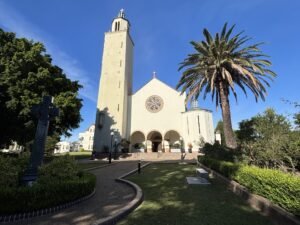
If someone in your family has died and they were Catholic, you may know that the funeral will involve the Church — but still have questions about what happens next.
Who do you contact first? Does the funeral have to be a Mass? Can family members give a eulogy? Can you choose the music and readings? What happens if you want a cremation?
Catholic funerals follow a particular structure, but there are still choices for families to make. This guide explains what to expect when arranging a Catholic funeral in Sydney, from the first conversation with your funeral director through to the Funeral Mass and committal.
If you’re looking for a funeral director to help arrange a Catholic funeral in Sydney, you can learn more about our Catholic Funeral Services.
Catholic funerals in Sydney at a glance
- A Catholic funeral may include a Vigil, Funeral Liturgy, Final Commendation and Rite of Committal.
- A Funeral Liturgy can be celebrated with or without Mass.
- A Funeral Mass is generally held in a Catholic church, chapel or oratory.
- Family and friends can usually participate through readings and words of remembrance.
- Cremation is permitted by the Catholic Church.
- Families can personalise many aspects of the funeral while working within the Church’s liturgical structure.
- Your funeral director can coordinate the practical arrangements with the parish and priest.
What is a Catholic funeral?
A Catholic funeral is more than a memorial or a celebration of life. It’s a set of funeral rites through which the Church commends the person who has died to God, while offering comfort and support to the family left behind.
Catholic funeral rites in Sydney can include:
- The Vigil for the Deceased
- The Funeral Liturgy — usually a Funeral Mass, though a liturgy outside Mass is also possible
- The Final Commendation
- The Rite of Committal, at the cemetery or crematorium
Not every funeral will include all of these elements, and the exact form will depend on the family’s circumstances, the parish and the wishes of the person who has died.
Who do you contact first?
You can start with your funeral director.
They’ll guide you through the practical arrangements and can contact the family’s parish on your behalf, or help you find one if there isn’t an existing connection.
From there, a meeting with the priest is arranged to talk through the funeral rites, readings, prayers, music and the order of service.
You don’t need to have everything decided before you make the first call. Your funeral director and the parish can guide you through what needs to happen and when.
What happens at a Catholic funeral in Sydney?
A Catholic funeral generally involves several stages: the Vigil, the Funeral Liturgy, the Final Commendation and the Rite of Committal. Where a Funeral Mass is celebrated, it forms the central liturgy.
The exact format depends on the family’s wishes, the parish and the circumstances.
Before the funeral
Once the parish and priest are involved, burial or cremation arrangements are finalised alongside the funeral planning meeting.
Your funeral director will coordinate the practical arrangements, while the priest or parish will guide the family through the Catholic funeral rites and liturgy.
The Vigil
The Vigil for the Deceased is often held the evening before the funeral, although arrangements can vary.
It may take place in a church, funeral home or another suitable setting and typically includes prayers, readings and time for family and friends to gather and remember the person who has died.
The Funeral Mass
In Sydney specifically, current guidance from the Archdiocese of Sydney Liturgy Office states that Funeral Masses should ordinarily be celebrated in Catholic churches, chapels or oratories. Funeral Liturgies outside Mass have additional location options.
The coffin is received with holy water and covered with a pall. The Mass includes Scripture readings, a homily from the priest and prayers of intercession, as well as the Eucharistic celebration.
There is also a place within the funeral rites for words of remembrance from family or friends. More about this is covered below.
The Final Commendation and Committal
The Final Commendation takes place as part of the funeral liturgy, before the person is taken to the place of committal.
The Rite of Committal then takes place at the cemetery, crematorium or another appropriate place of committal.
If someone has only recently died and you’re not yet at this stage, our guide to What to Do When Someone Dies in Sydney covers the practical first steps.
Does a Catholic funeral have to be a Funeral Mass?
No.
Catholic funeral rites can take the form of a Funeral Mass, but a Funeral Liturgy outside Mass is also recognised.
In Sydney specifically, current Archdiocese guidance is that a Funeral Mass should generally be celebrated in a Catholic church, chapel or oratory, while a Funeral Liturgy without Mass has some additional location options.
This can be worth knowing if your family has a reason to consider a different setting or would prefer a funeral without Mass.
Your funeral director and parish priest can explain which options are appropriate for your circumstances.
Can you have a eulogy at a Catholic funeral?
Yes.
A personal tribute can form part of a Catholic funeral, although you may hear it referred to as a “eulogy” or “words of remembrance”, depending on the parish, priest and family’s preference.
The priest’s homily has a different purpose. It reflects on the Scripture readings and the Christian hope of resurrection.
A eulogy or words of remembrance gives family or friends an opportunity to speak about the person who has died — their life, character, relationships and the things that made them who they were.
In our experience arranging Catholic funerals in Sydney, we’ve seen both terms used. Some families are asked to prepare “words of remembrance”, while others simply refer to the tribute as a “eulogy”.
If you’d like someone to speak at the funeral, it’s worth discussing it with the priest when the service is being planned so everyone is clear about when and how the tribute will be included.
Can a Catholic funeral include personal touches?
Yes.
Although a Catholic funeral follows the structure of the Church’s liturgy, there are still many opportunities to reflect the individual life of the person who has died.
Families may include:
- Photographs displayed at the church, including a video slideshow
- Meaningful music, chosen alongside the priest
- Flowers and personal symbols
- Readings selected by the family
- Words of remembrance
- Personal items that reflect the person’s life
There are liturgical guidelines around what can be included and where, so it’s worth raising anything you’d like early with your funeral director and the parish.
A Catholic funeral can honour both the person’s faith and the person themselves.
Can a Catholic be cremated?
Yes. Cremation is permitted by the Catholic Church, although there are specific requirements around the respectful treatment and final disposition of cremated remains. The National Liturgical Council provides further information about Catholic funeral rites, cremation and the care of ashes.
There are specific requirements around the respectful treatment and final disposition of cremated remains. If cremation is being considered, your funeral director and parish priest can explain the options and requirements.
How much does a Catholic funeral cost in Sydney?
There isn’t one fixed cost for a Catholic funeral in Sydney. The total will depend on the type of funeral and the choices made by the family.
Costs may include:
- Burial or cremation
- Funeral director fees
- Coffin or cremation arrangements
- Church or parish fees
- Cemetery or crematorium costs
- Flowers
- Death notices
- Printing and stationery
- Additional services such as an Order of Service booklet or slideshow
For a general sense of our pricing, see our Pricing Guide.
Catholic Funeral Q&A
Does a Catholic funeral have to include Mass?
No.
A Catholic funeral doesn’t necessarily have to include a Funeral Mass. A Funeral Liturgy outside Mass is also an option, and this can affect where the funeral can take place.
In the Archdiocese of Sydney, a Funeral Mass is generally celebrated in a Catholic church, chapel or oratory, while a Funeral Liturgy without Mass has additional location options. The Vigil and Rite of Committal may also take place in different settings.
The appropriate form depends on the family’s wishes, the circumstances and the guidance of the parish and priest.
Can family members speak at a Catholic funeral?
Yes.
Family members or friends may be invited to share words of remembrance about the person who has died.
If someone would like to speak, it’s best to discuss this with the priest when planning the funeral so the appropriate place and format can be agreed.
Can the family choose who gives the eulogy?
Generally, yes.
Families usually decide who will speak, whether that’s one person or several. It’s worth confirming this with the priest early in the planning so timing and format are clear on the day.
Can you personalise a Catholic funeral?
Yes.
Although a Catholic funeral follows a particular liturgical structure, there are many opportunities to reflect the individual life of the person who has died.
Readings, music, video slideshows, photographs, flowers, words of remembrance and personal items can all be included, subject to the guidance of the parish.
Can you choose the readings for a Catholic funeral?
Families can generally have input into the Scripture readings chosen for the funeral, in consultation with the priest or parish.
The readings are an important part of the Funeral Liturgy and are selected from those approved for Catholic funeral celebrations.
Can grandchildren or friends do a reading at a Catholic funeral?
Often, yes.
Many families involve grandchildren, friends or other relatives in the readings.
It’s a personal choice worth raising with the priest during planning so everyone knows their role ahead of time.
Can you choose the music for a Catholic funeral?
Music can be an important part of a Catholic funeral.
Families can discuss preferred hymns and music with the parish or priest, who can advise on what’s appropriate for the Mass or other liturgy.
If a particular piece of music is meaningful to the family, it’s worth mentioning it early in the planning process.
Can a Catholic funeral include secular music?
This can vary between parishes and priests.
Music used during the Funeral Mass generally needs to be appropriate to the liturgy, while families may have more flexibility around music at a Vigil, gathering or after the funeral.
If there’s a particular song that was meaningful to the person, mention it during the planning conversation with the priest.
Can photographs be included at a Catholic funeral?
Yes. Photographs can be an important way of remembering and honouring the person who has died.
Many families choose to create a video slideshow or photographic tribute using images from throughout the person’s life. This is often played as part of the wider funeral arrangements, such as at a Vigil, gathering or reception, rather than during the Funeral Mass itself.
Families may also choose to have a photograph or other personal item displayed at the church, depending on the parish’s arrangements.
If you’d like to create a photographic tribute, your funeral director can help you put together the images and presentation.
Can you have flowers at a Catholic funeral?
Yes.
Flowers are commonly part of a Catholic funeral, both at the church and at the committal.
Some parishes have their own guidance on placement, so it’s worth checking with the priest if you have something specific in mind.
Can you have a slideshow at a Catholic funeral?
A slideshow is more commonly part of a Vigil, reception afterwards or a separate gathering, rather than the Mass itself.
Idyllic can help put a slideshow together as part of the wider service if that’s something your family would like.
Can children participate in a Catholic funeral?
Yes.
Children are often involved in Catholic funerals — carrying items in the procession, doing a reading or simply being present as family.
Your priest can suggest age-appropriate ways for children to take part if you’d like their involvement.
Can a Catholic funeral be followed by cremation?
Yes.
A Catholic Funeral Mass can be followed by cremation rather than burial.
The Mass is generally held with the body present, followed by cremation and the appropriate final disposition of the cremated remains.
Can the Funeral Mass be held before cremation?
Yes.
A Funeral Mass can be celebrated with the body present before cremation, with the cremated remains then treated and laid to rest according to Catholic Church guidance.
Can the Funeral Mass be held at a crematorium?
This depends on the type of Catholic funeral being celebrated and the arrangements available at the crematorium.
A Funeral Mass is generally celebrated in a Catholic church, chapel or oratory. However, many Sydney crematoria have their own chapels, which can accommodate funeral services and, depending on the circumstances and the arrangements with the priest and parish, Catholic funeral liturgies.
If your family would prefer to hold the funeral at a crematorium, it’s worth discussing this with your funeral director and parish priest. They can explain what is possible at the particular crematorium and which form of Catholic funeral is appropriate.
Can Catholic funeral ashes be kept at home?
Church teaching includes specific guidance about the final disposition of cremated remains.
In general, cremated remains are to be treated with the same respect given to the body and are intended to be laid to rest in a dignified and appropriate place.
If you’re considering cremation, your parish priest or funeral director can explain the current requirements and options.
What happens if the person didn’t belong to a local Catholic parish?
You don’t necessarily need an existing relationship with a parish to arrange a Catholic funeral.
Your funeral director can help establish which parish to contact, often based on where the person lived or their connection with the Catholic community.
The priest can then discuss the arrangements and liturgy with the family.
Can someone who wasn’t a practising Catholic have a Catholic funeral?
This is something to discuss with a Catholic priest.
Someone who identifies as Catholic but hasn’t been regularly attending Mass doesn’t necessarily lose the option of a Catholic funeral. The circumstances and the family’s wishes should be discussed with the parish.
Your funeral director can help facilitate that conversation.
Can I have a Catholic funeral if my family hasn’t been to church for years?
Often, yes.
A long gap from regular churchgoing doesn’t automatically rule out a Catholic funeral.
It’s best discussed directly with a priest, who can talk through the family’s circumstances and what’s appropriate.
Can someone who wasn’t Catholic have a Catholic funeral?
It’s ultimately at the discretion of the parish and priest.
For example, the person may not have been Catholic themselves but the family may have a particular connection to the Church.
The circumstances can vary between parishes, so the best approach is to speak with the priest about the person’s connection to the Church and the family’s wishes.
Who arranges a Catholic funeral — the funeral director or the church?
Both have important roles.
The funeral director manages the practical aspects — transporting the person who has died, coordinating the service, arranging burial or cremation and liaising with other suppliers.
The priest and parish guide the family through the Catholic funeral rites and liturgy.
Your funeral director can coordinate between the two.
Can I arrange a Catholic funeral without using a Catholic funeral home?
Yes.
You don’t need a specifically “Catholic” funeral home. Any funeral director experienced in Catholic funeral rites can coordinate with the parish and priest on your behalf.
How soon after someone dies does a Catholic funeral take place?
There’s no single timeframe that applies to every Catholic funeral.
Timing depends on the circumstances of the death, parish and priest availability, the family’s wishes, and practical arrangements such as burial or cremation.
Your funeral director can help coordinate a suitable date with the parish.
Can a Catholic funeral be held on a weekend?
It depends on parish and priest availability, and sometimes on whether a weekend Mass schedule allows for it.
Your funeral director can check timing with the parish directly.
Do Catholic funerals have to be traditional?
No.
A Catholic funeral follows the structure and requirements of the Church’s funeral rites, but that doesn’t mean every funeral looks the same.
Within that structure, families can make choices that reflect the person who has died — music, readings, photographs, flowers and words of remembrance.
Can a Catholic funeral be a celebration of life?
A Catholic funeral and a celebration of life aren’t necessarily opposites.
A Catholic funeral follows the Church’s liturgical structure, while a celebration of life generally offers greater freedom over the format and content.
A Catholic funeral can nevertheless include many personal elements — stories, photographs, meaningful music, readings and words of remembrance — within that structure.
What’s the difference between a Catholic funeral Mass and a funeral service?
A Catholic Funeral Mass follows the Church’s set liturgical structure, including Scripture readings, a homily and Holy Communion.
A funeral service — such as one held outside the Catholic tradition, or a Funeral Liturgy without Mass — has more flexibility in structure and content.
What’s the difference between a Catholic funeral and a celebration of life?
A Catholic funeral is a religious rite centred on faith, prayer and the person’s passing into eternal life, held within the structure of the Church’s liturgy.
A celebration of life is generally a more flexible format focused on the person’s life, relationships and memories, without the set liturgical structure of a Catholic funeral.
What should I do first when arranging a Catholic funeral in Sydney?
Contact a funeral director and, if possible, the person’s parish.
You don’t need every detail decided before making the call.
Your funeral director can guide you through the practical arrangements and liaise with the parish, while the priest helps determine the appropriate rites and discusses the service with the family.
Arranging a Catholic funeral in Sydney
If you’re arranging a Catholic funeral, you don’t need to have everything worked out before you make the first call.
At Idyllic Funerals, we’ve arranged Catholic funerals across Sydney and can help coordinate the practical arrangements with your chosen parish and priest.
We’ll guide you through the process, answer your questions and make sure the funeral reflects both the person’s faith and the life they lived.
Learn more about our Catholic Funeral Services or get in touch with us.