In my work as a funeral director, I’m often reminded that while death is universal, the way we honour it is anything but. Around the world, across cultures, countries, and belief systems, people mark the end of life in deeply different ways.
What they all have in common is meaning. Ritual. Presence. And the need to gather and acknowledge what has been lost.
Learning how death is honoured around the world offers a powerful reminder that there is no single “right” way to farewell a life. Only what feels true to the person, the family, and the culture they belong to.
Mexico: Celebrating Life Through Colour and Story
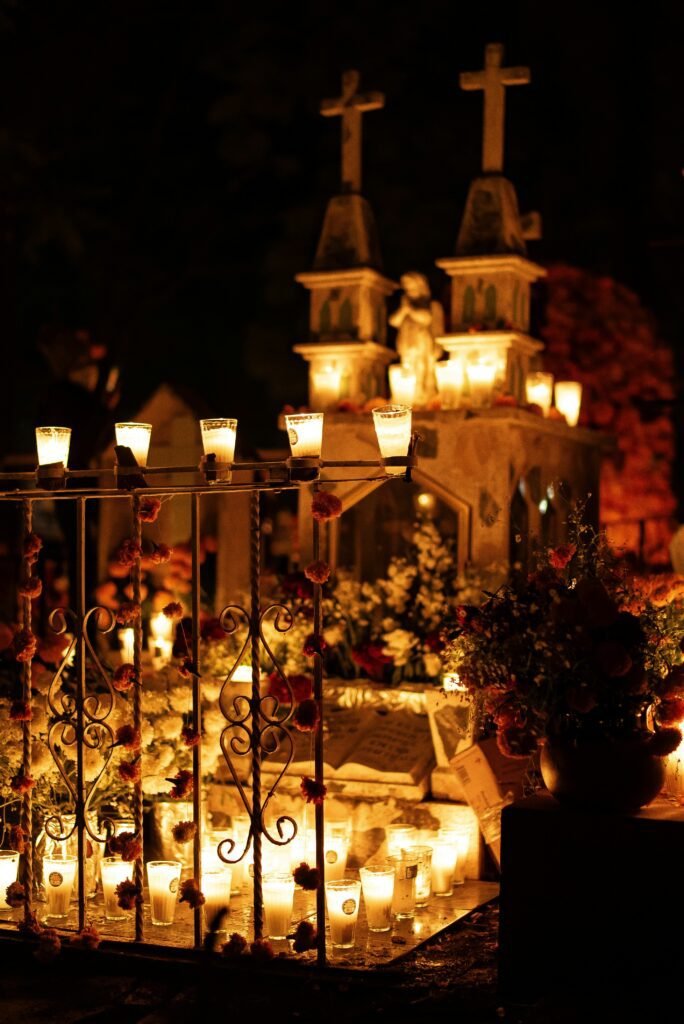
In Mexico, Día de los Muertos is one of the most well-known death rituals in the world. Rather than mourning quietly, families create vibrant altars filled with photos, marigolds, food, music, and candles to welcome the spirits of loved ones back for a brief visit.
It’s a beautiful example of how remembrance can be joyful. Death is not hidden or feared, but woven into daily life through storytelling and shared memory.
Japan: Reflection and Respect
In Japan, funerals are often deeply ritualised and rooted in Buddhist traditions. After death, family members wash the body and dress it carefully before cremation. This act is seen as one of respect and love.
Families return to the ashes afterward and use chopsticks to place bone fragments into an urn together, a quiet, shared moment that reinforces connection and continuity.
Ghana: A Celebration of Identity
In parts of Ghana, funerals can be large, colourful events where custom coffins are shaped to reflect the person’s life. A fisherman might be buried in a fish, a teacher in a book, a musician in an instrument.
These funerals celebrate achievement and identity rather than focusing solely on loss. They tell a story about who the person was and how they lived.
Tibet: Returning to the Earth
Tibetan sky burials are one of the most confronting rituals for Western cultures. In this tradition, the body is offered to vultures, symbolising generosity and the impermanence of the physical form.
Rather than clinging to the body, the focus is on releasing it and allowing life to continue in new ways. It can be challenging to understand from the outside, but for those who practise it, it is deeply spiritual.
Indonesia: Death as a Process, Not a Moment
Among the Toraja people of Indonesia, death is not considered immediate. Loved ones may remain at home for months or even years while families save for an elaborate funeral.
During this time, the deceased is treated as “sleeping” and included in daily life. The funeral itself becomes a major communal event, honouring the person’s journey and role in the community.
What We Can Learn From These Traditions Around the World
Across all these practices around the world, one thing stands out: death is rarely rushed or hidden. It’s acknowledged through ritual, community, and meaning.
In Australia, we’re slowly seeing a shift toward more personalised farewells, ceremonies that include storytelling, music, symbolism, and cultural traditions that truly reflect the person being honoured.
We’re also learning that funerals don’t have to look one particular way. They can be quiet or celebratory, spiritual or non-religious, traditional or entirely unique.
Bringing This Awareness Into Modern Funerals
At Idyllic Funerals, I work closely with families to create ceremonies that feel authentic. Sometimes that means using cultural rituals passed down through generations. Other times it means drawing inspiration from global traditions and adapting them to suit modern Australian life.
What matters most is intention. Taking the time to ask, “What would feel right?” rather than “What is expected?”
Final Reflections
Exploring how death is honoured around the world reminds us that farewell is not about rules. It’s about meaning, memory, and connection.
No matter where we live or what we believe, the act of gathering, pausing, and remembering is something we all share.
If you’re thinking about how you’d like your life to be honoured, or how to create a ceremony that truly reflects someone you love, I’m always here for a conversation.
👉 Learn more about our approach here
👉 Read more about some of these rituals here